Via Ferrata in Montenegro: The Complete Guide
How an iron path lets ordinary travellers climb extraordinary walls — and where to do it in Montenegro.
A via ferrata — Italian for “iron path” — is the most generous secret in the vertical world. It takes terrain that would otherwise belong only to trained climbers and, with a continuous steel cable and a set of fixed rungs, opens it to anyone with a reasonable head for heights and a willingness to keep moving upward. In Montenegro we now have two of them, both young, both spectacular, and both run by our certified mountain guides. This is everything you need to understand before you clip in.
What a via ferrata actually is
The concept was born in the Alps, where soldiers and shepherds first bolted iron ladders and cables to cliffs to cross ground that bare hands could not. The modern version keeps the same idea: a route is permanently equipped with a steel cable that runs the full length of the wall, anchored to the rock every few metres, and supplemented by metal rungs, staples, ladders and sometimes suspension bridges where the natural holds run out.
The result is a sport that sits squarely between hiking and rock climbing. You use your hands and feet on real rock and real iron, you gain real height, and you finish genuinely tired — but you never have to lead a pitch, place protection or tie a single knot. The cable does the technical work; you just keep climbing.
The safety system, explained simply
Everything hangs on one elegant piece of kit: the via ferrata lanyard. It is a Y-shaped set with two arms, each ending in a large carabiner, joined at your harness through a fabric shock absorber. The golden rule is that you are always attached by at least one carabiner.
How you move on the cable
- Both carabiners clip onto the steel cable and slide along as you climb.
- When you reach an anchor point — where the cable is bolted to the rock — you unclip one carabiner and move it past the anchor.
- Only then do you move the second carabiner across, so a moment of full attachment never lapses.
If you slip, the carabiners catch on the last anchor and the shock-absorbing element built into the lanyard tears or pays out in a controlled way, softening the load on your body. Certified sets conform to the European EN 958 standard, which is designed to protect climbers from roughly 40 kg up to 120 kg. On every guided route with us you also wear a helmet and harness and receive a full hands-on briefing before you leave the ground.
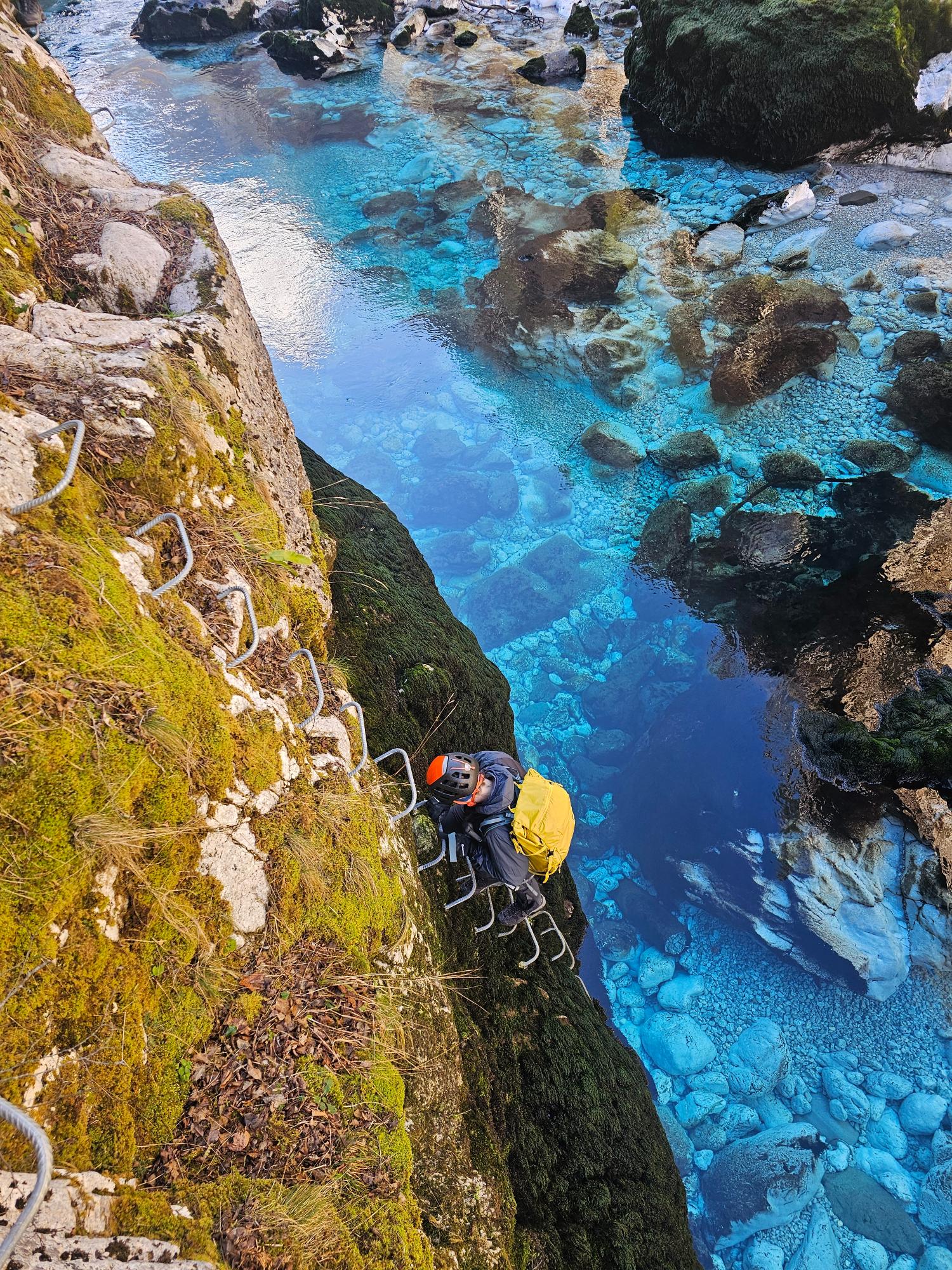
The cable does not make the height disappear. It makes the height survivable, so you are free to look around and enjoy it.
The two Montenegro routes
Both of our iron paths are recent additions to the country’s adventure map, and they could hardly be more different in character.
Via Ferrata Piva — the dramatic one
Strung across the rock face of the Piva Canyon near Plužine, this is the route for travellers who want exposure and reward in equal measure. It runs roughly 800 metres along the wall, reaching well over a hundred metres above the turquoise River Piva, and packs in cables, metal rungs, ladders and suspension bridges. Expect to spend around two hours on the rock. Read the full picture in our Via Ferrata Piva guide, or jump to the Piva tour page for dates and pricing.
Via Ferrata Orlina at Slano Lake — the gentle one
Above the shores of Slano Lake near Nikšić, the Orlina route is shorter, sunnier and far more forgiving. It is the family choice — suitable from age 12, around an hour on the cable, with panoramic views over the water the whole way. We cover it in detail in our Orlina at Slano Lake guide, and you can book it via the Slano via ferrata page.
Who can do it — and who should think twice
- Fitness: a moderate level is enough. If you can climb several flights of stairs without stopping, you can climb a beginner via ferrata.
- Experience: none required. This is genuinely the point of the sport — see our beginner’s guide if you have never clipped a cable.
- Age: from 12 on Orlina; Piva suits older teenagers and adults comfortable with sustained exposure.
- Fear of heights: mild nerves are normal and the security of the cable often dissolves them. A severe, paralysing fear of heights, or significant mobility issues, are the two honest reasons to choose a different adventure.
The gear — and what we provide
A complete via ferrata kit is a helmet, a climbing harness, the certified double-carabiner lanyard with its shock absorber, and gloves to protect your hands on the steel. On every tour we supply all of it, inspected and maintained to rescue-team standards — you bring only sturdy trainers or approach shoes, water, and clothing you can move in. There is nothing to buy and nothing to rent elsewhere.
Key facts
- Location
- Piva Canyon (Plužine) and Orlina at Slano Lake (Nikšić)
- Difficulty
- Beginner to moderate; no climbing experience needed
- Season
- Roughly spring to autumn, in dry conditions
- Duration
- ~1 h (Orlina) to ~2 h (Piva) on the cable
- Price
- from around €30 (Orlina) / €70 (Piva)
Once you understand how the iron path works, the only real question is which one suits you. If you are weighing it against roped climbing, our via ferrata vs rock climbing comparison lays out the trade-offs, and the via ferrata experience FAQ answers the practical worries. When you are ready, browse both routes on our via ferrata page and let our guides build the day around your group.